The DBEW Award explores how design can respond to technological, social and cultural transformation in the age of AI. Receiving Silver for Parallaxe was particularly meaningful because the project approaches artificial intelligence not only as a technical system, but as a new layer within human communication and democratic dialogue.
Design Beyond East and West
The DBEW Award brings together emerging designers from around the world and focuses on interdisciplinary approaches to contemporary social and technological challenges.
The 2026 edition received more than 800 submissions from 44 countries across spatial and architecture design, product and fashion design, and visual and communication design. The award ceremony took place at the ADI Design Museum during Milan Design Week.
Parallaxe was selected as a Silver Winner with Prof. Andreas Ingerl recognised as the project’s educator.
AI as a mediator in political dialogue
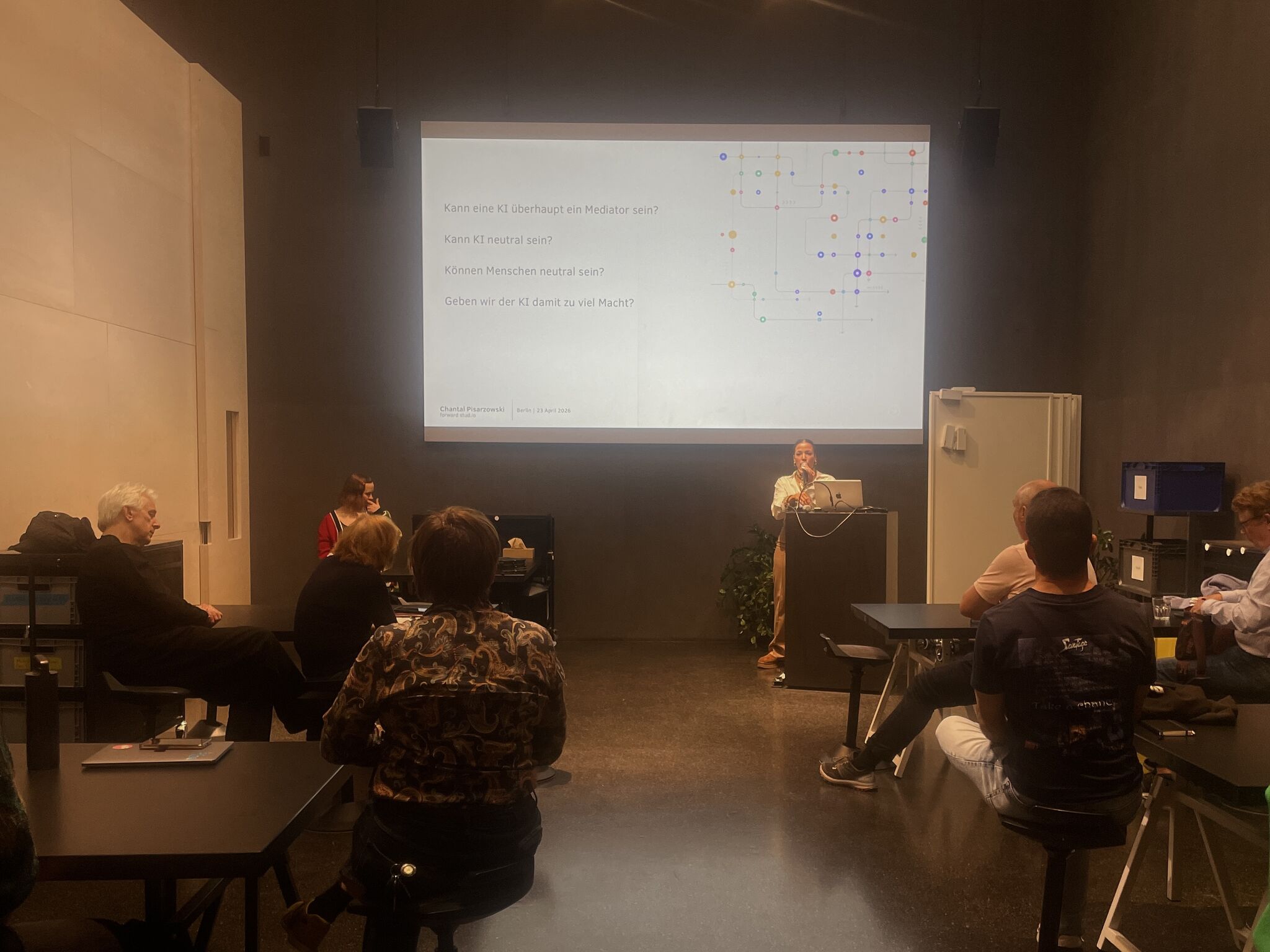
Parallaxe explores whether artificial intelligence can support conversations between people with opposing political views without deciding which position is correct.
The system matches participants based on differences in their political perspectives and mediates their conversation through a multi-agent architecture. It can reformulate emotionally charged language, ask clarifying questions, support communication across languages and provide source-based context when factual claims can reasonably be verified.
The DBEW jury recognised the project under the title “Parallaxe – AI as a mediator in political discussions.”
Designing the role of AI
One of the central design questions behind Parallaxe is not simply what an AI system is capable of doing, but what role it should be allowed to take within a sensitive human interaction.
A mediator influences how information is expressed, understood and interpreted. Introducing AI into that position therefore requires clear boundaries around intervention, uncertainty and authority.
Parallaxe is designed to support communication rather than replace human judgment. Participants remain responsible for their own positions, while the AI provides structure around the exchange.
Combining product design and AI systems
Developing Parallaxe required the interaction itself and the underlying AI architecture to evolve together.
User flows, conversational behaviour, mediation logic, translation and fact-checking cannot be treated as separate layers. Each technical capability changes what participants experience and what they expect from the system.
This makes the project part of my broader work across product and interaction design, human-AI interaction and agent systems: translating emerging AI capabilities into interfaces that people can understand, question and control.
Recognition for responsible AI design
The Silver Award places Parallaxe alongside international projects addressing social, environmental and technological challenges through design.
For me, the recognition also reinforces a broader idea behind the project: responsible AI is not only a question of model performance or governance. It is also a design problem.
How an intelligent system communicates uncertainty, when it intervenes, what authority it appears to have and how much control remains with the user are all decisions made through the design of the interaction.
Let’s keep in touch.
Discover more about our projects, pilots and interactive design. Follow us on LinkedIn and Instagram.