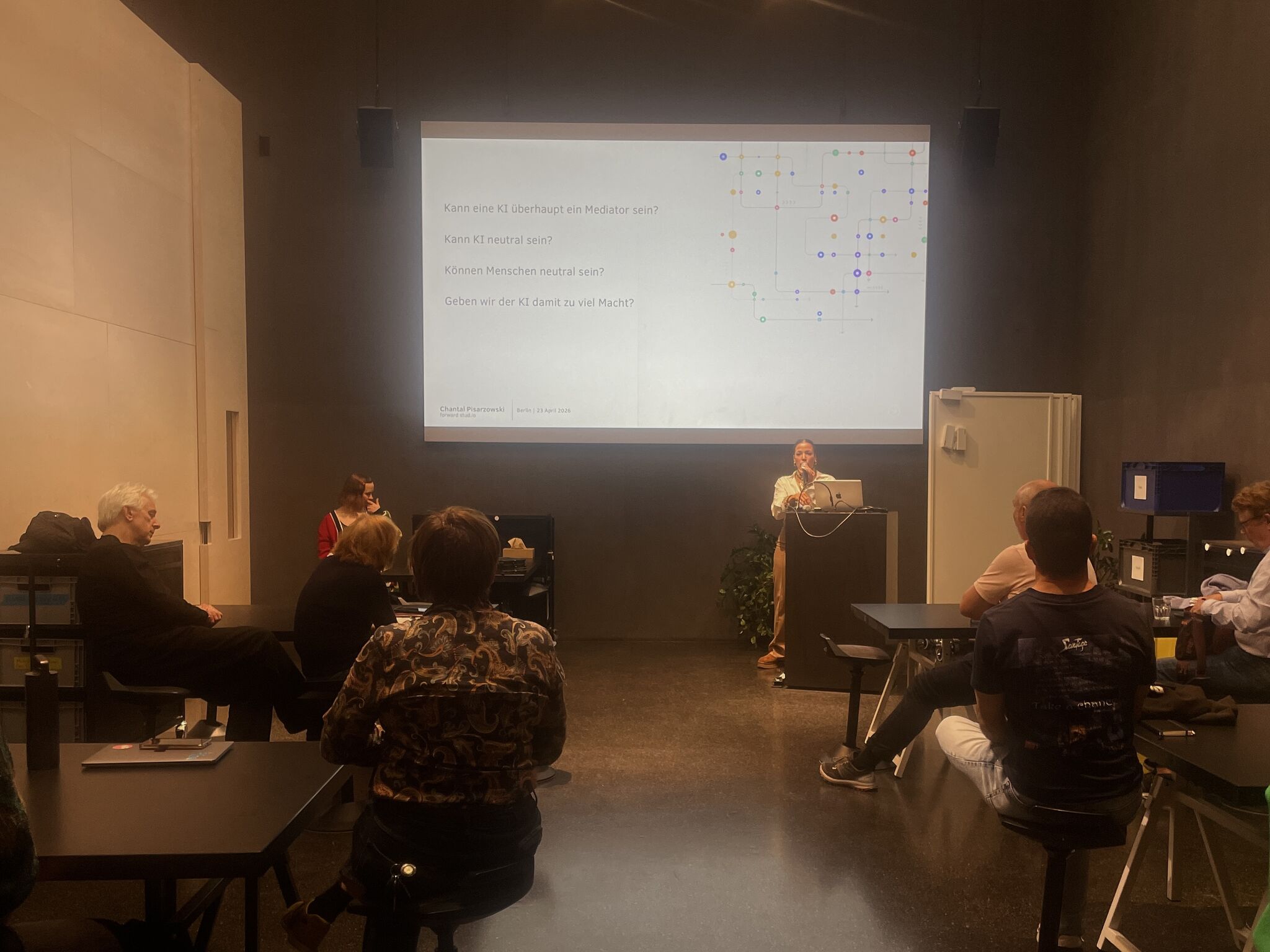
For the Futurium workshop, I substantially rebuilt Parallaxe so it could be tested with a larger group of people in a live setting for the first time. The evening became an important step in understanding how the system performs beyond small-scale testing, and which interaction patterns need to evolve in the next iteration.
Testing Parallaxe with a larger audience
Parallaxe is an AI-mediated dialogue system designed to support conversations between people with opposing political views.
Participants do not communicate directly. Instead, the system mediates the exchange by reformulating statements, asking clarifying questions and highlighting points of common ground.
At Futurium, visitors were able to test this interaction model themselves and experience how the AI intervenes within a live political conversation.
A technical deep dive into AI mediation
The workshop was not only about using the interface, but also about making the technology behind it understandable.
Together with Fraunhofer HHI, I introduced how language models operate within the system, what they can contribute to mediation and where their limitations become relevant.
This technical perspective was important because Parallaxe does not treat AI as an invisible layer. Understanding when and how the system intervenes is part of the interaction itself.
Live testing as part of the design process
The Futurium session made it possible to observe how people respond to Parallaxe under conditions that are difficult to reproduce in a controlled prototype test.
Different participants brought different expectations, political perspectives and levels of familiarity with AI. Their reactions revealed where the interaction felt intuitive, where mediation needed more explanation and where the system created new questions around control and trust.
Feedback from the testing and discussion directly informed the next iteration of the project.
Designing AI for disagreement
Political dialogue is a particularly demanding context for human-AI interaction.
An AI mediator needs to intervene without taking over the conversation, support clarity without erasing disagreement and provide structure without presenting itself as the authority.
Testing Parallaxe publicly helped surface these tensions in practice rather than only discussing them theoretically.
From prototype to public-facing AI system
Presenting Parallaxe at Futurium marked a shift from developing the system primarily as a research prototype toward testing how it behaves in a public-facing environment.
For me, this kind of live testing is essential when designing responsible AI systems. Technical performance alone does not show whether people understand the system, trust its interventions or know when to question them.
The Futurium workshop provided exactly that context: a space to test the technology, discuss its limits and use those observations to shape the next version of the product.
Let’s keep in touch.
Discover more about our projects, pilots and interactive design. Follow us on LinkedIn and Instagram.