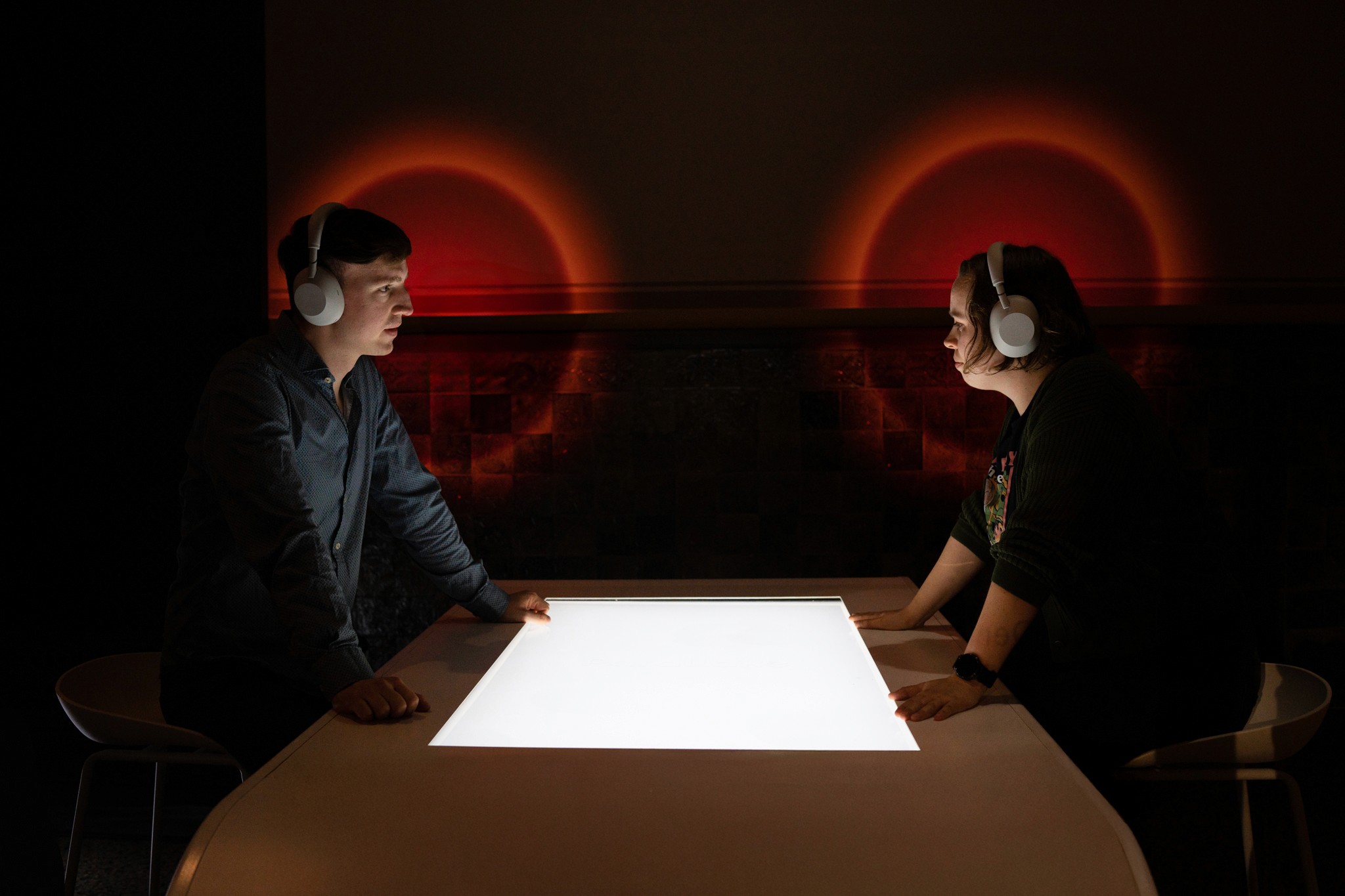
On 1–2 November 2025, Parallaxe moved from controlled testing into a public museum environment. The pilot explored how AI-mediated dialogue performs when people encounter the system in real time, with different political perspectives, languages and expectations around transparency, trust and control.
Testing AI-mediated dialogue in public
Parallaxe brings two people with opposing political views into a structured conversation mediated by AI.
Rather than communicating directly, participants speak through the system, which helps translate, reformulate and contextualise their contributions while preserving the substance of what they want to say.
Presenting the project during Berlin Science Week made it possible to observe how this interaction model works outside a controlled research setting and how visitors understand the role of AI within the conversation.
Real-time mediation
During a dialogue, Parallaxe can reformulate emotionally charged statements into more neutral language and ask follow-up questions when an argument remains unclear or requires additional context.
The aim is not to remove disagreement, but to create conditions in which opposing perspectives can be expressed and understood without immediately escalating the exchange.
The public pilot tested how these interventions are perceived when they happen live and where participants expect the system to explain or justify its behaviour.
Translation across languages and perspectives
Language can become an additional barrier when people with different cultural or linguistic backgrounds discuss complex political issues.
Parallaxe integrates real-time translation into the mediation process so participants can communicate across languages while remaining within the same structured dialogue.
This also raises broader questions around how AI systems interpret tone, context and meaning when mediation and translation happen simultaneously.
Source-based context and uncertainty
When a statement contains a verifiable claim and sufficient evidence is available, Parallaxe can introduce transparent, source-based context into the conversation.
The system is also designed to distinguish between claims that can reasonably be checked and statements that involve opinion, interpretation or insufficient evidence.
For me, this distinction is essential to responsible AI mediation. A system should not create artificial certainty simply because it is technically capable of generating an answer.
From prototype to public experience
Testing Parallaxe at Museum für Naturkunde Berlin introduced conditions that are difficult to reproduce in a closed prototype session: unfamiliar users, limited onboarding time, spontaneous conversations and immediate expectations around usability and trust.
These conditions made the pilot particularly valuable for understanding where the interaction works intuitively and where the system needs to communicate its role, limitations and interventions more clearly.
The experience became another step in developing Parallaxe from an experimental AI system into a product that can operate responsibly in public-facing contexts.

Let’s keep in touch.
Discover more about our projects, pilots and interactive design. Follow us on LinkedIn and Instagram.